
How We Build a Concrete Pour
Rhino has built driveways and other flatwork in Long Beach, Signal Hill, and nearby cities, including equipment pads and house foundations, the same basic way. The details change with the site, the soil, and the drain path. This page walks through the steps so you know what a pour actually involves, whether you are a homeowner or a GC. For a look at your job, call or text (562) 824-2092.
Site check
Walk the job with you or with the property contact. Look at the existing slab, the soil, where water is sitting or running, truck access, and any city or HOA rules that may apply. Talk through what stays, what gets replaced, and whether your city may want a permit. Check with your city to be sure. The site check is also where we say if a repair is enough or if a new pour is the honest call.
Demo and haul-off
Saw-cut and break out the old concrete that is coming out. Protect nearby finishes as much as the site allows. Load and haul the debris off. This step is about a clean hole and a clear site, not about saving a slab that has already failed.
Grading and base
Grade the area and pack a solid base so the new slab is not sitting on loose or pumping dirt. Clay or wet ground gets extra attention at this step, because a pour on soft ground can fail early. The base is set for the job we're looking at.
Forms
Set forms to the planned shape, edges, and elevation. This is how the slab gets a clean line and the right height next to the house, the sidewalk, or the existing approach.
Rebar
Place rebar in the forms so the slab has reinforcement through the pour. Bar size and spacing are not listed on this page. Those get set for the job.
Pitch and drainage
Set the pitch so water runs away from the house or building, not back at it. Add a drain, a swale, or a tie-in when the site needs one. Standing water on or under a slab is a problem we plan for before the pour, not something to shrug off after the first rain.
Pour and finish
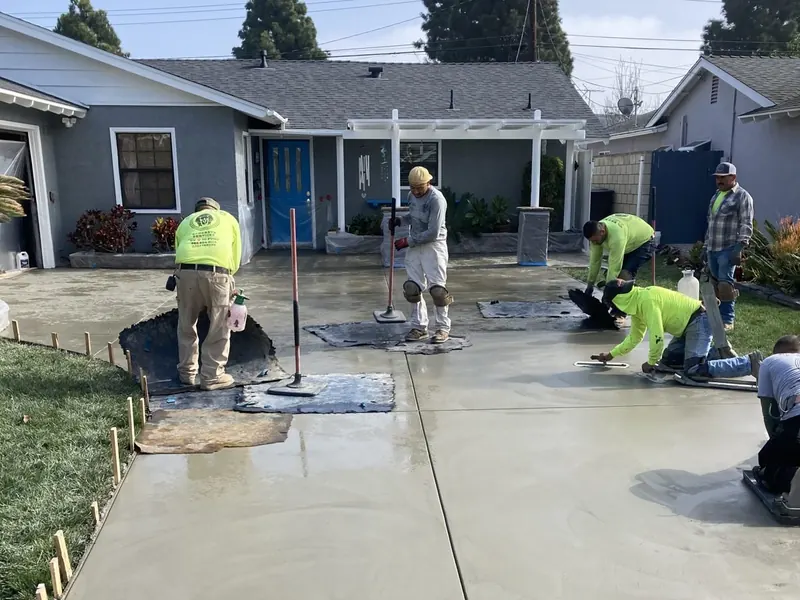
Pour the concrete, strike it off, and finish the surface to the look agreed on for the job. Work the edges and keep the slab consistent.
Joints
Tool or cut joints so the slab has a planned place to move as it cures, which helps keep cracks where we want them. Joint layout is part of the job, not an afterthought. Concrete can still crack, and joints help control where.
Curing and cleanup
Protect the new concrete while it cures. Leave clear stay-off guidance for that job, not a generic number of days on this page. Clean up the site and haul off leftover debris.
If you want us to look at a driveway, patio, sidewalk, pad or foundation in Long Beach, Signal Hill, or a nearby city, call or text (562) 824-2092.
Get an Estimate
Tell us about the job. We'll get back to you as soon as we can. Have photos? Text them to (562) 824-2092.